In the early stages of a system, service communication often starts with static hostnames and configuration files. One service knows that another is available at a specific IP address and port, and requests are routed accordingly.
This approach works surprisingly well until infrastructure becomes dynamic.
Modern microservice platforms routinely scale services horizontally, replace unhealthy instances automatically, and deploy new versions without downtime. A service that was running on one node five minutes ago may now be running somewhere entirely different.
Without a discovery mechanism, every consumer must constantly know where every provider is currently located. As the number of services grows, maintaining those relationships quickly becomes an operational burden.
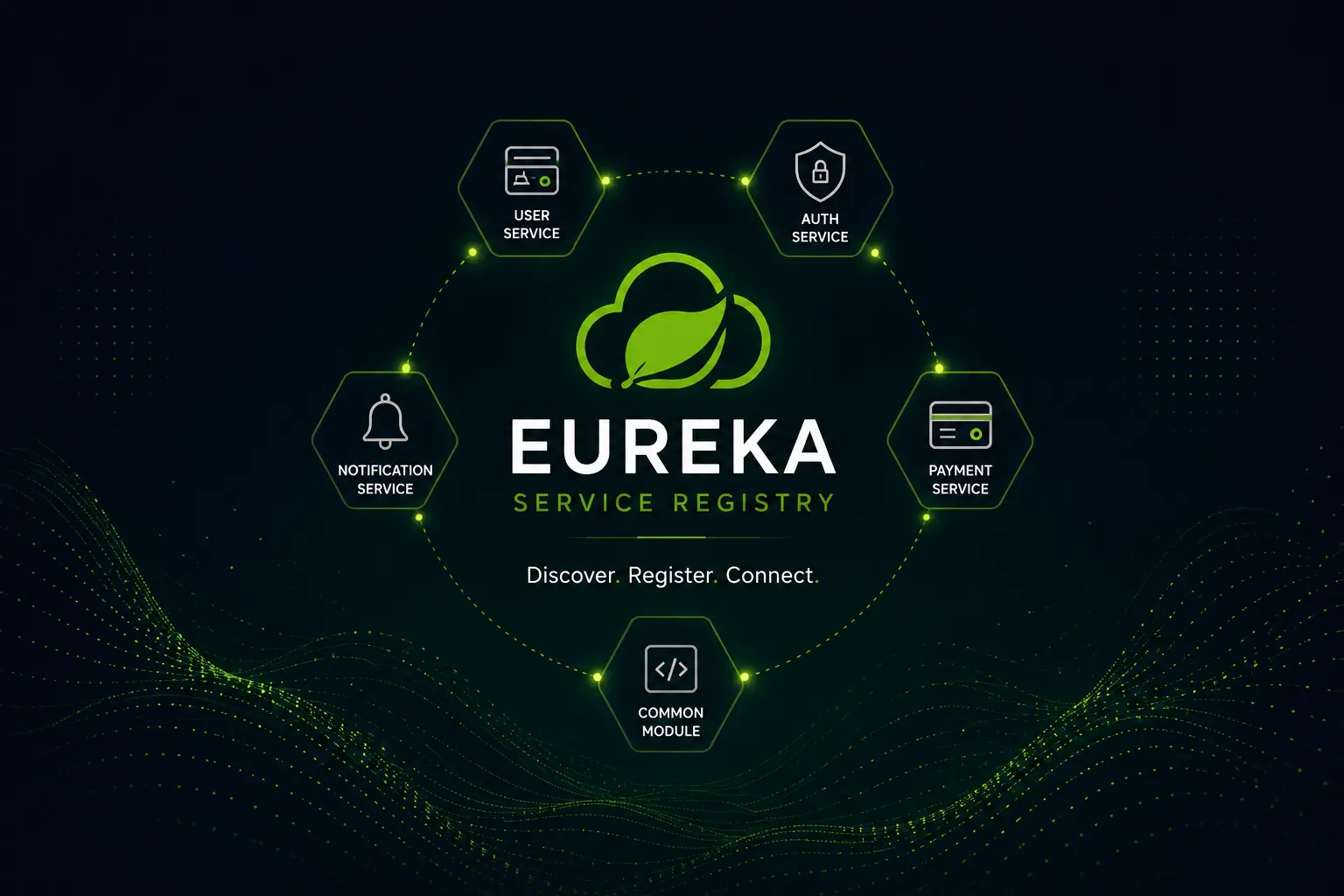
Service discovery solves this challenge by introducing a central registry that continuously tracks the location and health of running services. Rather than communicating through fixed addresses, services discover each other dynamically at runtime.
In this article, we’ll examine how Netflix Eureka enables dynamic service discovery within a Spring Boot microservices platform, why it remains relevant today, and what considerations are required when operating it in production.
Why Service Discovery Exists
Microservices introduce a unique challenge that rarely exists in monolithic applications: service location becomes dynamic.
Consider a Payment Service running at:
http://10.0.1.4:8080
If that instance crashes and Kubernetes schedule a replacement, the new instance may be launched at:
http://10.0.8.17:8080
Every consumer relying on the old address immediately fails.
One possible solution is continuously updating configuration files, but this approach becomes unmanageable as infrastructure scales.
Service discovery introduces a dedicated registry that maintains an up-to-date directory of available service instances.
When a service starts:
- It registers itself with the registry.
- It periodically sends heartbeat signals.
- It is automatically removed if heartbeats stop.
Consumers query the registry instead of relying on static network addresses.
This creates loose coupling between services and infrastructure, enabling automated scaling, failover, and deployment workflows without requiring configuration changes.
Why We Chose Eureka
Several service discovery technologies exist today. Common options include:
- Netflix Eureka
- Consul
- Zookeeper
- Kubernetes Service Discovery
- DNS-based discovery
For this platform, Eureka offered the best balance between simplicity and integration with Spring Cloud.
Its native support for:
- Spring Boot
- Spring Cloud Gateway
- Client-side load balancing
- Health-based registration
allowed us to focus on business capabilities rather than discovery infrastructure.
For organizations already operating entirely within Kubernetes, native service discovery may be sufficient. However, for teams building Spring Boot ecosystems that need lightweight service registration with minimal operational overhead, Eureka remains a practical and proven solution.
Eureka vs Alternatives
| Capability | Eureka | Consul | Kubernetes DNS |
|---|---|---|---|
| Spring Integration | Excellent | Good | Good |
| Service Health Tracking | Yes | Yes | Partial |
| Service Metadata | Yes | Yes | Limited |
| Multi-Datacenter Support | Limited | Excellent | Good |
| Operational Complexity | Low | Medium | Medium |
| Kubernetes Native | No | Partial | Yes |
There is no universal correct choice. The right solution depends on infrastructure maturity, deployment model, and operational requirements.
Architecture & Tech Stack
| Component | Details |
|---|---|
| Language & Framework | Java 21 & Spring Boot 4.0.3 |
| Framework | Spring Cloud Netflix Eureka Server |
| Discovery Protocol | REST-based heartbeat registration (every 30s) |
| Eviction Policy | Nodes failing to heartbeat within 90s are automatically deregistered |
| Dashboard | Built-in web UI at port 8761 showing all registered instances |
Registration Lifecycle
The service discovery lifecycle follows four simple stages:
1. Service Startup
When a service starts, it registers itself with Eureka and publishes metadata including:
- Service name
- Host
- Port
- Health endpoint
- Instance identifier
2. Heartbeat Phase
Each service periodically sends heartbeat messages. These heartbeats act as proof that the instance remains healthy and reachable.
3. Service Discovery
Consumers query Eureka to retrieve healthy instances matching a service identifier.
4. Deregistration
If heartbeats stop for a configured period, Eureka automatically removes the instance from the registry. This prevents traffic from being routed to unavailable services.
Dependencies
To set up the Service Registry Architecture with Spring Cloud Gateway and Spring Eureka, include the following dependencies.
					<dependencies>
    <dependency>
        <groupId>org.springframework.boot</groupId>
        <artifactId>spring-boot-starter-web</artifactId>
    </dependency>
    <dependency>
        <groupId>org.springframework.cloud</groupId>
        <artifactId>spring-cloud-starter-netflix-eureka-server</artifactId>
    </dependency>
</dependencies>

<dependencyManagement>
    <dependencies>
        <dependency>
            <groupId>org.springframework.cloud</groupId>
            <artifactId>spring-cloud-dependencies</artifactId>
            <version>${spring-cloud.version}</version>
            <type>pom</type>
            <scope>import</scope>
        </dependency>
    </dependencies>
</dependencyManagement>
Code Deep Dive: The Entire Service in 3 Lines
The Service Registry contains virtually zero custom Java code. The @EnableEurekaServer annotation spins up a full Eureka dashboard, REST API, and instance tracking state machine.
ServiceRegisteryApplication.java
					server:
  port: 8761

eureka:
  client:
    register-with-eureka: false  # Don't register yourself
    fetch-registry: false        # Don't download your own registry
Configuration: Preventing Self-Registration
By default, Spring Cloud applications try to register themselves with Eureka. The registry itself shouldn’t do this — it would clutter the dashboard and waste resources.
application.yml
					@SpringBootApplication
@EnableEurekaServer
public class ServiceRegisteryApplication {

    public static void main(String[] args) {
        SpringApplication.run(ServiceRegisteryApplication.class, args);
    }
}
*Figure: Eureka Dashboard screenshot showing registered instances: API-GATEWAY, USER-SERVICE, PAYMENT-SERVICE, NOTIFICATION-SERVICE with their IPs and ports*
Service Discovery Diagram

Production Considerations
Although Eureka is simple to deploy, production environments introduce additional considerations.
High Availability
A single Eureka server becomes a critical dependency. Production deployments should operate multiple Eureka nodes configured as peers. This ensures service discovery remains available even if one node fails.
Heartbeat Tuning
Heartbeat intervals directly impact failover speed. Short intervals improve responsiveness but increase network traffic. Long intervals reduce overhead but delay failure detection. The optimal configuration depends on service criticality and infrastructure scale.
Self-Preservation Mode
Eureka includes a self-preservation mechanism designed to prevent accidental mass deregistration during network partitions. While this feature improves resilience, teams should understand its behavior during large-scale outages to avoid confusion during incident response.
Monitoring
At minimum, monitor:
- Registered instance count
- Heartbeat failures
- Registry replication status
- Discovery latency
Service discovery failures often manifest as application failures elsewhere, making proactive monitoring critical.
Common Mistakes
- Hardcoding Service Addresses: The entire purpose of service discovery is eliminated if services continue referencing static IPs.
- Running a Single Registry Node: Creates an unnecessary single point of failure.
- Excessive Heartbeat Frequency: Generates unnecessary network traffic.
- Ignoring Metadata: Metadata can be used for version awareness, zone awareness, and routing decisions. Many teams never leverage these capabilities.
Conclusion
Service discovery is one of the foundational building blocks of a successful microservices architecture. Without it, dynamic scaling, automated recovery, and infrastructure mobility become significantly more difficult to achieve.
Netflix Eureka provides a lightweight yet effective mechanism for tracking service availability and location in real time. By allowing services to register themselves and consumers to discover them dynamically, it removes the need for static infrastructure assumptions and enables systems to evolve independently.
Although newer platforms often rely on Kubernetes-native discovery, Eureka remains a practical and accessible option for Spring Boot ecosystems seeking simple and reliable service registration. When combined with an API Gateway and centralized security, it becomes a key component in building resilient and scalable distributed systems.
Source Code: https://github.com/inexture-solutions/springboot-microservices/tree/main/service-registery
FAQs
Is Eureka still relevant in 2026?
Yes. While Kubernetes-native discovery has become increasingly common, Eureka remains widely used in Spring Cloud ecosystems and continues to provide a simple service discovery solution for JVM-based microservices.
Can Eureka replace a load balancer?
No. Eureka provides discovery information. Load balancing is typically performed by Spring Cloud LoadBalancer, API Gateways, or external infrastructure.
Does Eureka work outside Kubernetes?
Yes. Eureka works equally well on Virtual machines, Bare-metal servers, Docker environments, and Cloud platforms.
What happens if Eureka becomes unavailable?
Existing service-to-service communication continues to function using cached discovery information. However, newly started instances may not be discoverable until registry availability is restored.