Spring Boot with Drools Rule Engine Integration Guide for Enterprise Applications
By Mahipalsinh Rana May 20, 2025
Why Use Drools with Spring Boot?
Drools enables enterprises to separate business decisions from application logic, making systems easier to change, audit, and scale.
- Financial rules & eligibility checks
- Pricing & discount engines
- Fraud detection logic
- Policy & compliance validation
- Workflow decisioning
Using Drools with Spring Boot helps:
- Reduce hardcoded if-else logic
- Enable non-developers to manage rules
- Improve maintainability
- Support complex decision trees
- Achieve regulatory compliance
This approach is widely adopted in Enterprise Software Development programs where decision logic must remain independent from core application releases.
Drools as a Business Rules Engine
Drools is a forward-chaining rules engine based on the Rete algorithm, optimized for evaluating large rule sets efficiently.
Key Drools components:
Rules (.drl files) – Declarative business logic
- KIE Base – Compiled rules
- KIE Session – Runtime rule execution
- KIE Container – Versioned rule packaging
Drools is widely used in banking, insurance, healthcare, telecom, and enterprise SaaS platforms.
Spring Boot + Drools Architecture
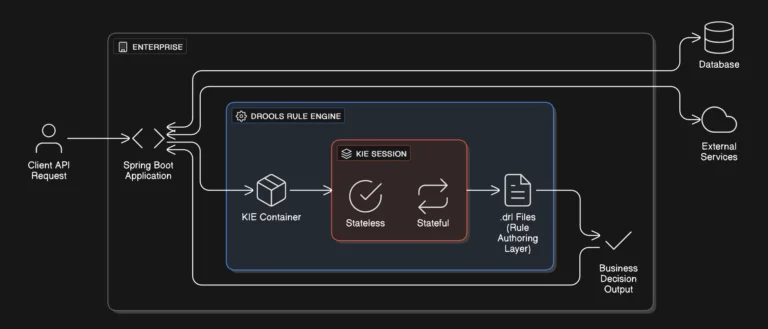
A typical Spring Boot with Drools architecture consists of multiple clearly separated layers, a common pattern followed by enterprise Backend Engineering teams building rule-driven systems.
Key layers include:
- Client / API Layer
Receives requests and prepares facts for rule evaluation. - Spring Boot Application Layer
Manages request handling, security, transactions, and orchestration. - Drools Rule Engine
Executes business rules using KIE containers and sessions. - Rule Authoring Layer
.drl files maintained independently from Java code. - Decision Output Layer
Rules return decisions consumed by services, workflows, databases, or external systems
Choosing the Right KIE Session Type
| Session Type | Best For | Characteristics |
|---|---|---|
| Stateless | APIs, validations | No memory, faster execution |
| Stateful | Long workflows | Maintains state across rules |
Enterprise applications often use stateless sessions for performance, while stateful sessions are used in workflow-driven systems like insurance claims or policy engines, often alongside strategies discussed in Java Caching & Distributed Locking for low-latency decision execution.
Integrating Drools with Spring Boot
					KieServices kieServices = KieServices.Factory.get();
KieContainer kieContainer = kieServices.getKieClasspathContainer();
StatelessKieSession kieSession = kieContainer.newStatelessKieSession();
kieSession.execute(facts);
In enterprise systems, Drools is usually wrapped inside a decision service layer, keeping controllers clean and rule execution isolated.
Enterprise Use Cases for Drools
- Loan eligibility & credit scoring
- Dynamic pricing engines
- Insurance policy validation
- Fraud detection rules
- Compliance & regulatory checks
- Workflow decision routing
These rule engines often act as the decision core within Workflow Automation systems and policy-driven enterprise platforms.
Production Best Practices for Drools
- Keep rules small and readable
- Avoid embedding Java logic inside rules
- Version rules using KIE containers
- Use stateless sessions wherever possible
- Monitor rule execution time
- Log rule activations for audits
- Separate rule ownership from developers
In regulated environments, rule services are commonly deployed alongside secure infrastructure patterns such as those covered in Redis SSL Configuration to ensure encrypted communication across enterprise systems.