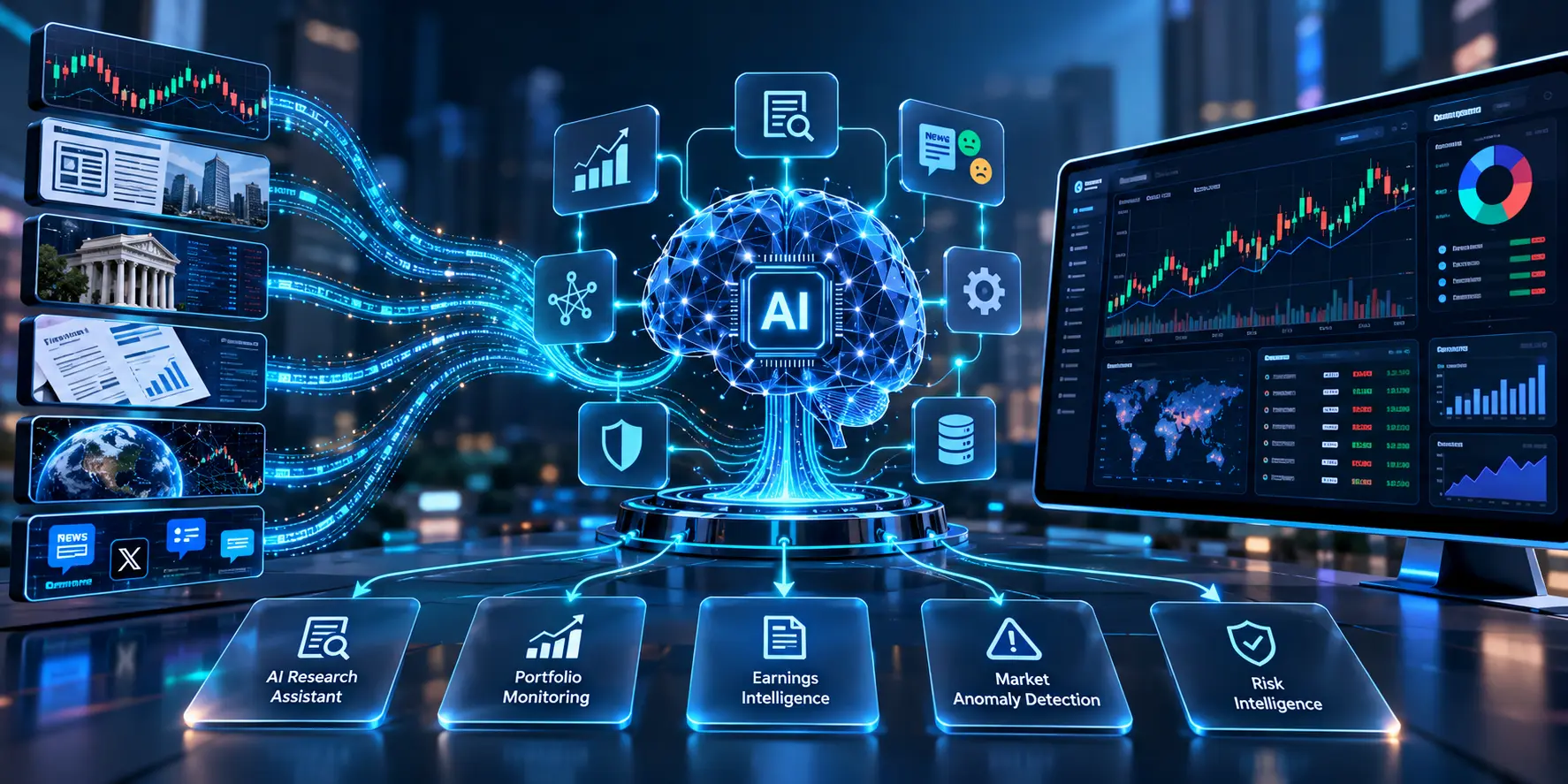
Agentic AI for stock market intelligence is creating new opportunities to build smarter financial products. By combining deep learning, AI agents, natural language processing, and financial data, businesses can develop intelligent platforms for stock research, portfolio monitoring, market analysis, and risk intelligence.
Instead of spending hours collecting information, your analysts start with insights, signals, and questions worth investigating.
This is the opportunity behind Agentic AI + Deep Learning for Stock Market Intelligence.
The combination of AI agents, deep learning, natural language processing, and financial data can turn a traditional market research workflow into an intelligent product that continuously monitors, analyzes, and explains what is happening in the market.
And this is not limited to stock prediction. Businesses can use the same foundation to build financial research platforms, portfolio intelligence tools, risk monitoring systems, investment research assistants, and personalized market intelligence products.
What Could You Build with Agentic AI?
The most interesting part is not simply using AI to analyze stocks. It is building a product around a specific financial problem.
For example, imagine a platform where a user selects a company or portfolio and the system automatically:
- Tracks relevant market movements
- Monitors company announcements and filings
- Analyzes financial news
- Identifies unusual activity
- Evaluates market sentiment
- Compares current conditions with historical data
- Summarizes potential risks
- Explains why a particular event may matter
- Delivers personalized alerts
Instead of users searching across multiple platforms, your product becomes an AI-powered financial research assistant.
Where Deep Learning Fits
Deep learning provides the analytical engine behind many of these capabilities.
It can process large and complex datasets such as:
- Historical price and volume data
- Financial statements
- Earnings reports
- Market indicators
- News and company announcements
- Economic data
- Sentiment signals
- Volatility patterns
Rather than relying on a single indicator, a product can combine multiple signals to create a broader view of market conditions.
For example, a system could detect unusual trading activity and then automatically investigate whether recent company news, earnings information, or broader sector movements could explain it.
That is where the combination of deep learning + agentic AI becomes particularly powerful.
From AI Model to AI Product
A predictive model by itself is only one component.
The real product opportunity comes from connecting models with data, workflows, user interfaces, and business rules.
A simplified product architecture could look like:
Financial Data → AI Models → Agentic Research → Risk Analysis → Personalized Insights → User DashboardThe AI agent acts as the coordinator.
It can decide which approved data source to consult, which analytical model to use, what information is relevant, and how the final insight should be presented.
This creates a foundation for building products rather than simply experimenting with an AI model.
Product Ideas You Could Build
1. AI Stock Research Assistant
Build a platform where investors and analysts can ask questions about companies and receive research supported by current financial information.
Instead of manually reviewing multiple sources, users receive a structured view of:
What happened → Why it matters → Supporting evidence → Potential risks2. Intelligent Portfolio Monitoring Platform
Create an AI system that continuously monitors a portfolio and highlights significant changes.
For example:
“Three companies in your portfolio reported earnings this week. One experienced a significant change in guidance, while another shows increased volatility.”
The product becomes a personalized monitoring layer rather than another generic market dashboard.
3. AI Earnings Intelligence
Imagine a product that monitors earnings announcements and automatically extracts the information investors care about.
It could identify changes in:
- Revenue
- Profitability
- Guidance
- Growth expectations
- Management commentary
- Risk factors
Users receive the important information without manually reading lengthy reports.
4. Market Anomaly Detection
Build a system that continuously looks for unusual market behavior.
When an anomaly is detected, the agent can investigate related news and financial events and provide context instead of simply displaying an alert.
That transforms:
“Something unusual happened.”
into:
“Something unusual happened, and here are the factors that may explain it.”
5. AI Financial Research Copilot
A research-focused product could help analysts investigate companies faster.
Users could ask questions such as:
- What changed in this company’s latest earnings?
- What are the major risks?
- How has the company’s performance changed?
- What events could affect the sector?
- Which recent announcements deserve attention?
The system could gather information, compare sources, and prepare a research brief for human review.
Why Agentic AI Makes These Products More Powerful
Traditional analytics often require users to know exactly what they want to search for.
Agentic AI can make the workflow more proactive.
For example:
Traditional system:
User searches → System returns data → User interprets it.Agentic system:
System monitors → Detects an important event → Investigates relevant information → Connects supporting signals → Explains the finding → Alerts the user.This shift from searching for information to receiving contextual intelligence is where many new product opportunities emerge.
A Practical Product Workflow
Consider an AI-powered portfolio intelligence platform.
Step 1: User Creates a Watchlist
The user selects companies, sectors, or portfolios they want to monitor.
Step 2: AI Continuously Monitors Data
The platform processes approved market, company, and news sources.
Step 3: Deep Learning Detects Patterns
Models identify unusual movements, changing sentiment, volatility, or other predefined signals.
Step 4: AI Agent Investigates
The agent gathers relevant context from approved sources.
Step 5: Intelligence Is Generated
The platform converts the information into a concise explanation.
Step 6: User Receives an Alert
Instead of receiving hundreds of raw notifications, users receive only relevant insights with supporting context.
This is the difference between building another financial dashboard and building an intelligent financial product.
What Makes the Product Valuable?
The strongest products are not necessarily the ones with the most AI features.
They solve a specific problem exceptionally well.
| Product Approach | User Value |
|---|---|
| Generic stock dashboard | Shows information |
| AI research assistant | Explains information |
| Portfolio intelligence | Personalizes information |
| Anomaly detection | Finds important changes |
| Earnings intelligence | Saves research time |
| AI research copilot | Accelerates analysis |
The opportunity is to identify a specific user problem and then use AI to make that workflow faster, smarter, and more personalized.
Building It Responsibly
Financial AI requires strong controls.
A production system should consider:
- Data quality and freshness
- Model validation
- Time-aware backtesting
- Model drift
- Data security
- Auditability
- Human review
- Access controls
- Clear AI limitations
Most importantly, AI-generated intelligence should not be presented as guaranteed investment outcomes.
A well-designed product helps users understand information and evaluate possibilities rather than pretending to predict the market with certainty.
The Bigger Opportunity
The real opportunity is larger than stock prediction.
The same architecture can support products for:
- Investment research
- Wealth management
- Portfolio monitoring
- Financial risk analysis
- Market intelligence
- Corporate finance
- FinTech analytics
- Economic research
- Financial news intelligence
Organizations can start with one focused use case and gradually expand the platform as the underlying data, AI models, and workflows mature.
FAQs
Can I build my own AI-powered stock intelligence product?
Yes. A product can be designed around a specific workflow such as stock research, portfolio monitoring, earnings analysis, market alerts, or financial sentiment analysis.
Do I need to build my own AI model?
Not necessarily. A product can combine existing AI models with specialized deep learning models, financial data, retrieval systems, and business logic.
What is the biggest opportunity with agentic AI in finance?
One major opportunity is automating multi-step research. Instead of simply returning data, an AI system can collect information, analyze it, connect relevant events, and present the results in a useful context.
Can this become a commercial SaaS product?
Yes. Potential SaaS models include subscription-based research platforms, portfolio intelligence tools, analyst copilots, enterprise financial intelligence platforms, and API-based financial analytics.
How should a company start?
Start with one clearly defined problem. Build a focused proof of concept, validate the data and AI outputs, introduce human review, and then expand the product based on real user feedback.