AWS Lambda is a cornerstone of modern cloud-native and serverless architectures. It allows enterprises to run backend logic without managing servers, automatically scaling based on demand and charging only for actual execution time.
This guide explains what AWS Lambda is, how it fits into enterprise architecture, when to use it, cost considerations, and best practices for production-grade serverless systems.
Why AWS Lambda Matters for Modern Enterprises
Enterprises are moving away from always-on servers toward event-driven, scalable, and cost-efficient architectures. AWS Lambda plays a key role by enabling teams to focus on business logic instead of infrastructure management.
AWS Lambda helps enterprises:
- Eliminate server provisioning & patching
- Scale instantly for unpredictable workloads
- Reduce infrastructure cost significantly
- Build highly decoupled, event-driven systems
- Accelerate time-to-market
Lambda is widely used in FinTech, SaaS, logistics, healthcare, eCommerce, and government platforms.
What Is AWS Lambda?
AWS Lambda is a Function-as-a-Service (FaaS) offering from AWS that lets you run code in response to events — without provisioning or managing servers.
Key characteristics:
- Stateless execution
- Automatic scaling
- Millisecond-level billing
- Event-driven invocation
- Deep integration with AWS services
Lambda functions are triggered by events such as:
- HTTP requests (API Gateway)
- File uploads (S3)
- Database changes (DynamoDB Streams)
- Messages (SQS / SNS)
- Scheduled jobs (EventBridge)
Common Enterprise Use Cases for AWS Lambda
- Backend APIs for web & mobile apps
- Event-driven data processing
- Real-time file & image processing
- Payment & transaction workflows
- ETL & data transformation jobs
- Automation & cron replacements
- Microservices & integration layers
AWS Lambda Architecture Overview
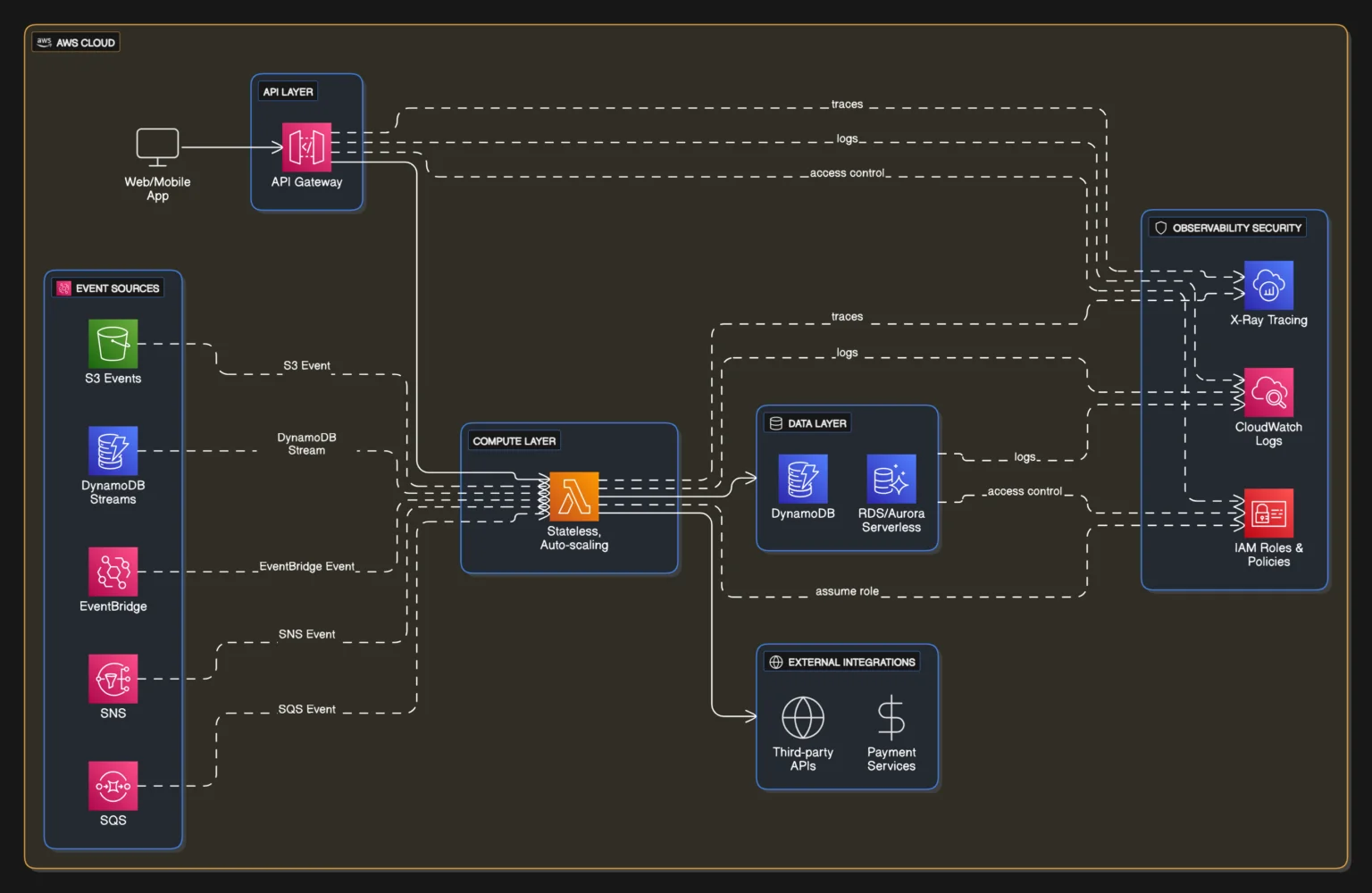
In an enterprise serverless architecture, AWS Lambda typically sits at the center of an event-driven system.
Core architectural components include:
- Client Applications (Web / Mobile)
- API Gateway (request routing & auth)
- AWS Lambda functions (business logic)
- Event sources (S3, SQS, SNS, EventBridge)
- Data stores (DynamoDB, Aurora Serverless)
- Security (IAM roles & policies)
- Observability (CloudWatch, X-Ray)
AWS Lambda Languages & Runtime Support
AWS Lambda supports multiple runtimes:
- Java
- Python
- Node.js
- .NET
- Go
- Ruby
Enterprises typically choose:
- Java / .NET for complex enterprise logic
- Python for data processing & automation
- Node.js for APIs & lightweight microservices
AWS Lambda Pricing & Cost Considerations
| Cost Component | Description |
|---|---|
| Execution Time | Charged per millisecond |
| Memory Size | Higher memory = higher CPU |
| Requests | Charged per invocation |
| Data Transfer | Standard AWS networking charges |
Indicative Monthly Cost
- Small workloads: $5 – $20
- Medium enterprise systems: $50 – $300
- High-scale event systems: $500+
Why Enterprises Save Cost
- No idle server cost
- Pay only for execution
Automatic scaling eliminates over-provisioning
AWS Lambda Limitations (Enterprise Perspective)
- Execution timeout (max 15 minutes)
- Cold start latency (important for APIs)
- Not ideal for long-running jobs
- Limited local disk space
- Complex debugging vs traditional servers
Avoid Lambda For
- Heavy CPU-bound workloads
- Long-running batch jobs
- Low-latency, always-warm systems
Best Practices for Production-Grade AWS Lambda
- Keep functions small & single-purpose
- Use environment variables for config
- Apply least-privilege IAM policies
- Enable structured logging
- Use retries & DLQs for failure handling
- Monitor with CloudWatch & X-Ray
- Combine Lambda with Step Functions for workflows