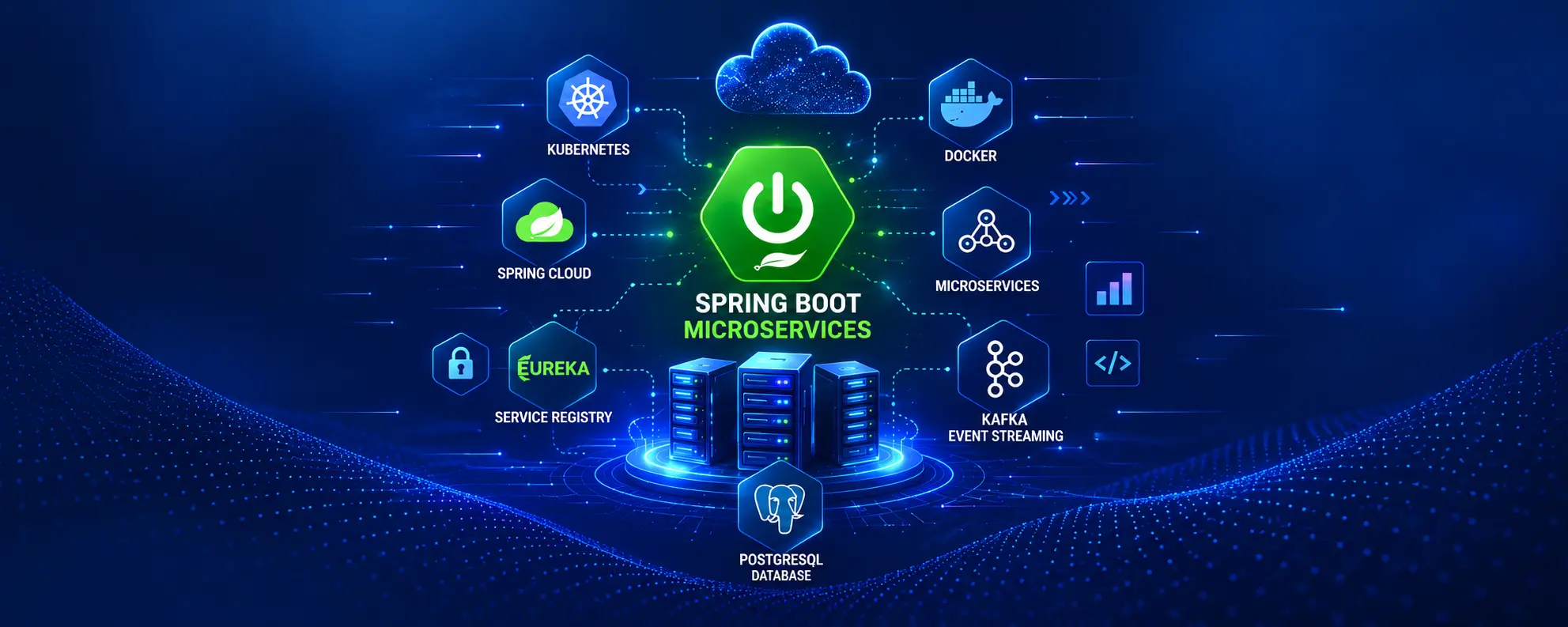
Building a successful microservices platform requires far more than splitting a monolithic application into smaller services.
Many organizations successfully create microservices but struggle with the operational complexity that follows. Service discovery, authentication, routing, asynchronous communication, distributed transactions, observability, deployment automation, and infrastructure standardization quickly become more challenging than the business functionality itself.
A production-grade microservices platform must address these concerns systematically.
This series documents the architecture, design decisions, and implementation patterns behind a Spring Boot microservices platform built around clear service boundaries, centralized security, event-driven communication, and operational resilience.
Rather than focusing solely on framework configuration, this series examines how individual platform components work together to create a scalable, maintainable, and production-ready ecosystem.
By the end of the series, readers will understand not only how the platform is implemented, but why each architectural decision was made and the trade-offs involved.
The Problem We Set Out To Solve
Many Spring Boot microservices tutorials focus on creating services but rarely address platform architecture.
A realistic production environment introduces challenges such as:
- How do services find each other?
- How is authentication enforced consistently?
- How do services communicate asynchronously?
- How are shared standards maintained?
- How do new services join the ecosystem?
- How do teams prevent architectural drift?
Solving these problems independently in every service creates duplication and inconsistency.
Our objective was to establish a reusable platform foundation capable of supporting multiple business domains while maintaining consistent operational and security standards.
The resulting architecture separates infrastructure concerns from business concerns and allows each service to focus on a single responsibility.
Architecture Principles
Before discussing individual services, it is important to understand the principles guiding the platform.
Single Responsibility
Every service owns one clearly defined capability.
Examples:
- User Service manages identity data.
- Authorization Service issues tokens.
- Notification Service delivers notifications.
- Payment Service processes payments.
Stateless Services
Wherever possible, services remain stateless.
State is stored in:
- PostgreSQL
- Kafka
- JWT Claims
- Not every interaction requires synchronous REST communication.
- Operations such as notification delivery are naturally asynchronous and therefore leverage Kafka messaging.
- This improves resilience and reduces service coupling.
- Authentication is validated at the platform boundary through the API Gateway.
- Services assume authenticated traffic and focus on business authorization.
- Cross-cutting concerns are centralized within the Common Module.
- This reduces implementation drift and improves consistency across services.
High-Level Platform Architecture
The platform consists of several independent services working together.
Each service owns a specific responsibility while relying on shared infrastructure for discovery, security, and communication.

Why These Technologies?
Many technologies could have been selected for this platform.
The chosen stack reflects a balance between simplicity, scalability, and developer productivity.
Spring Boot
Provides:
- Mature ecosystem
- Strong community support
- Enterprise adoption
- Rapid development
PostgreSQL
Selected because:
- Proven reliability
- ACID compliance
- Excellent Spring integration
- Strong operational tooling
Kafka
Selected because:
- Reliable asynchronous communication
- Retry capabilities
- Decoupled architectures
- Independent service scaling
JWT Authentication
Selected because:
- Stateless authentication
- Horizontal scalability
- Reduced dependency on centralized session stores
Eureka
Selected because:
- Lightweight service discovery
- Strong Spring Cloud integration
- Low operational overhead
Service Responsibilities
One of the most common causes of microservice complexity is unclear service ownership.
Each service in this platform owns a specific business or infrastructure capability.
Responsibilities are intentionally narrow to prevent excessive coupling and overlapping ownership.
| Service | Role |
|---|---|
| service-registry | Eureka Server – service discovery |
| api-gateway | Single entry point – routing, security, monitoring |
| common-module | Shared library – exceptions, responses, utils |
| user-service | User identity, RBAC, OTP persistence |
| auth-service | JWT issuance via RS256, asymmetric keys |
| notification-service | Kafka consumers, email/notification delivery |
| payment-service | Stripe & Razorpay – idempotent webhook handling |
How A Request Flows Through The Platform
Understanding how services interact is often more valuable than understanding individual implementations.
Consider a typical authenticated user request:
- Step 1: The client sends a request to the API Gateway.
- Step 2: The gateway validates the JWT.
- Step 3: The gateway resolves the destination service using Eureka.
- Step 4: The request is forwarded to the appropriate service.
- Step 5: Business processing occurs.
- Step 6: If asynchronous work is required, Kafka events are published.
- Step 7: Notification Service consumes events and delivers notifications independently.
This workflow demonstrates how platform responsibilities remain separated while still working together cohesively.
Why This Architecture Scales
The architecture is designed around independent scalability.
Examples:
- Payment Traffic Spike: Payment Service can scale independently. User Service remains unchanged.
- Notification Surge: Notification Service consumers can increase without affecting API latency.
- Authentication Load: Additional Authorization Service instances can be deployed without impacting business services.
New Business Domain: New services can join the platform while reusing Gateway, Service Discovery, Security, and Common Module. This minimizes platform onboarding effort.
Production Readiness Considerations
The platform incorporates several production-oriented practices.
- Database Migrations: Flyway manages schema evolution.
- Stateless Authentication: JWT eliminates server-side session storage.
- Service Discovery: Eureka enables dynamic infrastructure.
- Event-Driven Processing: Kafka isolates non-critical workloads.
- Standardized Error Handling: Common Module enforces consistency.
- Horizontal Scalability: Services can scale independently based on workload.
What This Platform Does Not Solve
No architecture solves every problem.
Current limitations include:
- Distributed Transactions: Services maintain independent databases. Cross-service transactions require additional patterns.
- Multi-Region Deployments: Current design focuses on single-region operation.
- Service Mesh Features: Capabilities such as mTLS, traffic shaping, and advanced observability would require technologies such as Istio or Linkerd.
- Advanced Event Streaming: Current Kafka usage focuses primarily on integration events. More advanced streaming architectures may require additional patterns.
Platform Implementation Details
Below is a brief overview of the implementation details for each core service.
Prerequisites
- Java 21 SDK – all services require Java 21.
- Maven 3.6+ – build and dependency management.
- PostgreSQL – used by auth-service and user-service.
- Apache Kafka – required for OTP events and notification delivery.
- Docker (optional) – fastest way to spin up PostgreSQL and Kafka locally.
service-registry
Netflix Eureka Server. Maintains a live directory of every running service instance. The API Gateway resolves downstream addresses from Eureka - no hardcoded hostnames anywhere.
- Auto-registration, health heartbeating, dynamic routing.
api-gateway
The single front door for the entire platform. No client talks directly to a backend service.
- Dynamic routing via Eureka, JWT enforcement, Monitoring via Spring Actuator/Prometheus.
common-module
A shared Maven library, not a running service.
- GlobalExceptionHandler, standard API responses, reusable search specs, shared constants.
user-service
The identity core. Manages user accounts, RBAC roles, and publishes OTP events.
- OAuth2 Resource Server, Flyway migrations, Kafka OTP events, i18n support.
auth-service
Authenticates users and issues signed JWT access tokens using asymmetric RS256 keys.
- RS256 asymmetric signing, no per-request auth calls, reads user_service schema.
notification-service
Kafka consumer only. Listens to events and delivers notifications asynchronously.
- Decoupled by design, retry resilience, extensible channels.
payment-service
Provider-agnostic payment processing supporting Stripe and Razorpay.
- Factory pattern, async webhook handling, idempotent events, circuit breakers (Resilience4j).
Running the Full Platform Locally
Start the services in this specific order. Each step depends on the one before it being healthy and registered with Eureka.
Step 1 - Infrastructure
Start PostgreSQL and Apache Kafka.
Step 2 - Common Module
Install the shared library into your local Maven repository. This only needs to be done once, or whenever the common-module changes:
					cd common-module
mvn clean install
					cd service-registry
./mvnw spring-boot:run
Wait until the Eureka dashboard is accessible at http://localhost:8761 before proceeding.
Step 4 - Backend Services
Start user-service and auth-service. Either order works, but both must be running before the gateway starts:
					# Terminal 1
cd user-service && mvn spring-boot:run
					# Terminal 2
cd auth-service && ./mvnw spring-boot:run
					# Terminal 3
cd notification-service && mvn spring-boot:run
					# Terminal 4
cd payment-service && mvn spring-boot:run
					cd api-gateway
./mvnw spring-boot:run -Dspring-boot.run.profiles=local
Once the gateway is up, all services are accessible through it. Check the Eureka dashboard at http://localhost:8761 to confirm every service is registered and healthy.
Environment Variables: Each service reads its database credentials, Kafka brokers, and issuer URI from environment variables or application.yml. Review each service’s README for the full list of required variables before starting.
Continue The Series
- Part 1 – Service Registry
- Part 2 – API Gateway
- Part 3 – Common Module
- Part 4 – User Service
- Part 5 – Authorization Service
- Part 6 – Notification Service
- Part 7 – Payment Service
Conclusion
Microservices are not simply smaller applications. They represent a fundamentally different approach to designing, deploying, and operating software systems.
A successful platform requires more than service boundaries. It requires consistent approaches to authentication, service discovery, communication, observability, and governance.
This Spring Boot microservices platform combines these capabilities into a cohesive architecture built around clear ownership, centralized security, asynchronous communication, and operational simplicity.
The remaining articles in this series explore each component individually, examining not only how they were implemented but why each architectural decision was made and the trade-offs involved.
Whether you are building your first distributed system or refining an existing platform, understanding these foundational patterns is essential for long-term scalability and maintainability.
FAQs
Why use microservices instead of a monolith?
Microservices provide independent deployment, scaling, and ownership at the cost of increased operational complexity.Is this architecture suitable for small applications?
Not always.
Smaller applications may benefit from a modular monolith before adopting distributed services.
Why was Kafka chosen over REST communication?
Kafka supports asynchronous communication, fault isolation, and independent scaling.
Why separate Authentication and User Management?
Authentication and identity management evolve differently and benefit from separate ownership boundaries.
Can this architecture run without Kubernetes?
Yes.
The platform works on virtual machines, Docker environments, and cloud infrastructure.