Businesses generate data from applications, customer interactions, transactions, connected devices, and enterprise systems. However, collecting data is only the first step. Organizations need the right infrastructure to process, secure, manage, and transform that information into meaningful business insights.
This is where modern data platforms become essential.
A well-designed data platform helps businesses integrate information from multiple sources, improve data accessibility, support real-time analytics, and make informed decisions. It also provides the foundation for business intelligence (BI), predictive analytics, and AI-powered applications.
Building such a platform requires more than choosing cloud storage or analytics tools. It involves designing a scalable architecture, establishing strong security practices, and continuously optimizing performance.
Let’s explore the key strategies businesses should consider when building modern data platforms.
What Is a Modern Data Platform?
A modern data platform is an integrated technology environment that collects, stores, processes, manages, and delivers data for analytics and business applications. Implementing this infrastructure often requires specialized data engineering solutions that connect business systems and transform raw information into usable insights.
Unlike traditional data systems that often operate in isolated environments, modern platforms connect multiple data sources through centralized or logically integrated data architectures.
A typical platform includes:
- Data ingestion: Collecting information from databases, APIs, applications, and external systems.
- Data storage: Managing structured, semi-structured, and unstructured information.
- Data processing: Transforming raw information into consistent, usable datasets.
- Data governance: Maintaining data quality, ownership, security, and compliance.
- Analytics and reporting: Supporting dashboards, business intelligence, and advanced analytics.
For example, an eCommerce business can integrate customer orders, website activity, inventory, and payment information into one analytics environment. This allows decision-makers to monitor sales trends, understand customer behavior, and improve inventory planning.
Build a Scalable Data Platform Architecture
Scalability is one of the most important considerations when designing a modern data platform. As businesses grow, data volumes, processing requirements, and the number of users accessing information also increase.
A scalable architecture should accommodate this growth without requiring a complete infrastructure redesign.
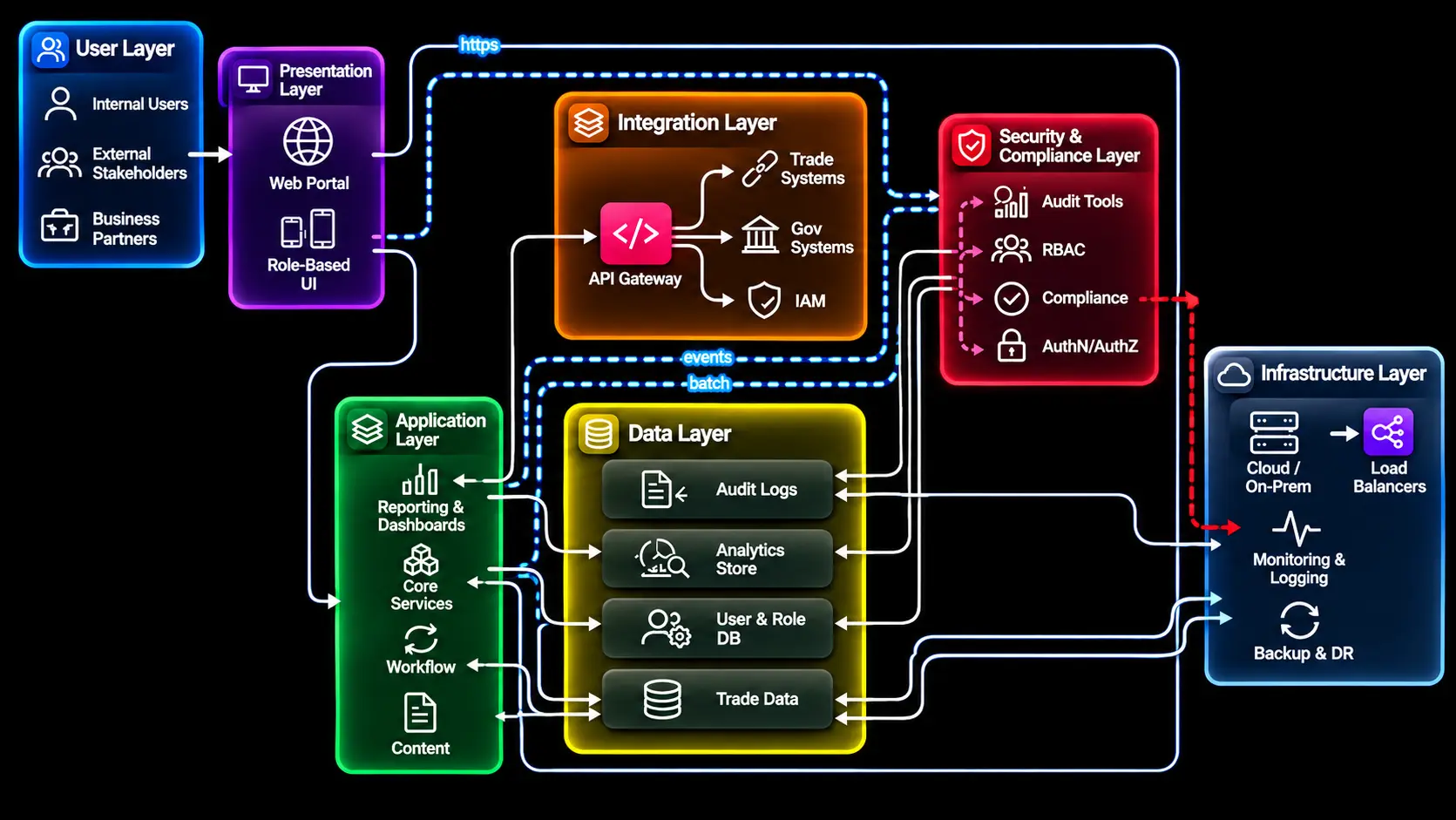
Key architectural components include:
Data ingestion layer: Connect internal and external systems through APIs, database connectors, batch processing, or event streaming tools.
Storage layer: Use cloud object storage, data warehouses, or lakehouse architectures based on data types, workloads, and analytical requirements.
Processing layer: Implement distributed processing frameworks and transformation pipelines to handle increasing workloads.
Consumption layer: Make trusted datasets available to BI dashboards, reporting systems, machine learning applications, and business users.
Choosing the Right Data Architecture
| Architecture | Best suited for | Key advantage |
|---|---|---|
| Data Warehouse | Structured business reporting | Optimized analytical queries |
| Data Lake | Large volumes of diverse data | Flexible and cost-effective storage |
| Lakehouse | Unified analytics and AI workloads | Combines lake flexibility with warehouse capabilities |
Businesses should select an architecture based on data complexity, analytical workloads, governance requirements, and long-term objectives rather than following technology trends.
For growing organizations, a modular architecture with independently scalable storage and processing components can provide greater flexibility.
Choosing the right infrastructure and deployment strategy is equally important, making Cloud & DevOps services valuable for building and managing scalable cloud environments.
Strengthen Data Security and Governance
As data platforms connect more business systems, protecting sensitive information becomes increasingly important.
A security-focused architecture should protect information throughout its lifecycle, from ingestion and storage to processing and consumption.
Consider these essential practices:
- Encryption: Protect sensitive information both at rest and in transit.
- Role-based access control (RBAC): Give employees access according to their responsibilities.
- Data classification: Identify sensitive, confidential, and publicly accessible information.
- Data masking: Protect personal and financial information when full details are unnecessary.
- Audit logging: Maintain records of data access, modifications, and administrative activities.
- Backup and recovery: Establish recovery procedures to reduce the impact of infrastructure failures or accidental data loss.
Data governance should also establish clear ownership, metadata management, retention policies, and data quality standards.
For example, a financial services company may restrict customer transaction information to authorized departments while allowing management teams to access aggregated financial reports.
This approach improves data protection without preventing employees from accessing the information they need.
Optimize Data Platform Performance
A scalable platform must also deliver consistent performance. Slow queries, inefficient transformations, and unnecessary data movement can affect reporting accuracy, operational efficiency, and user experience.
Businesses can improve platform performance through several strategies.
- Optimize data processing: Use parallel processing and efficient transformation workflows for large datasets.
- Implement incremental loading: Process only new or modified records instead of repeatedly loading entire datasets.
- Use indexing and partitioning: Organize data to improve query execution and reduce unnecessary scanning.
- Apply caching: Store frequently accessed results to reduce repeated database operations.
- Monitor workloads: Track query execution time, pipeline failures, resource consumption, and processing delays.
- Optimize resource allocation: Scale computing resources according to actual workload requirements.
Example: Incremental Data Processing
Consider a business that processes millions of customer transactions every day. Reloading its complete transaction history for every reporting cycle can increase processing time and infrastructure costs.
Instead, an incremental pipeline processes only newly created or updated records.
A simplified SQL example:
SELECT
    transaction_id,
    customer_id,
    transaction_amount,
    transaction_date
FROM source_transactions
WHERE updated_at > :last_processed_timestamp;
The extracted records can then be validated, transformed, and loaded into the analytics environment.
The timestamp should be managed through a reliable pipeline checkpoint, with appropriate handling for late-arriving records, retries, and duplicate events.
This approach reduces unnecessary processing while helping keep analytical datasets current.
Choose the Right Data Integration Strategy
Business information often exists across multiple systems, including CRM platforms, ERP applications, payment gateways, databases, and third-party APIs.
Without effective integration, organizations may experience fragmented information, inconsistent reporting, and duplicated records.
Businesses exploring modern integration approaches can also read our guide on real-time data integration for BI platforms.
A modern integration strategy should support both batch and real-time data processing.
| Integration approach | How it works | Business application |
|---|---|---|
| Batch Processing | Processes data at scheduled intervals | Daily financial reporting |
| Real-Time Streaming | Processes events as they occur | Fraud detection and live monitoring |
| API Integration | Exchanges data between applications | CRM and ERP synchronization |
| Change Data Capture (CDC) | Captures database changes | Continuous database synchronization |
The right approach depends on how quickly information needs to be available and how critical processing latency is to business operations.
For example, inventory management may benefit from near-real-time updates, while monthly financial reporting may work effectively with scheduled batch processing.
Implement Data Quality and Observability
Even a technically advanced data platform cannot deliver reliable insights if its underlying information is inaccurate or incomplete.
Data quality should be monitored throughout the ingestion and transformation lifecycle.
Important quality checks include:
- Accuracy: Does the information correctly represent real-world records?
- Completeness: Are required fields and records available?
- Consistency: Do different systems follow the same data definitions?
- Uniqueness: Are duplicate records identified and handled?
- Timeliness: Is information available within the expected processing window?
For example, an order analytics pipeline should validate transaction IDs, customer references, order amounts, and timestamps before publishing the final dataset.
Data observability extends these checks by monitoring pipeline health, freshness, schema changes, processing failures, and unexpected data patterns.
You can also explore our Secure File Transfer & Automated ETL Pipeline case study to see a relevant example of secure data movement and automated data processing.
This helps engineering teams identify issues before they affect business reports or downstream applications.
Prepare the Platform for Analytics and AI
Modern data platforms should support today’s reporting requirements while remaining flexible enough for future business applications.
Once reliable datasets are available, organizations can build additional capabilities, including:
- Business intelligence dashboards for operational visibility.
- Predictive analytics for demand and revenue forecasting.
- AI-powered recommendations based on customer behavior.
- Automated anomaly detection for identifying unusual patterns.
- Machine learning pipelines for intelligent business applications.
For a practical example of data-driven platform development, explore Inexture’s DataDrive Analytics Platform case study, which demonstrates a relevant application of analytics platform engineering.
For example, a retail business can combine historical sales, inventory levels, and seasonal trends to develop demand forecasting models.
However, successful AI adoption depends on data quality, appropriate access controls, and reliable processing pipelines. AI capabilities should build on a well-governed data foundation rather than operate on disconnected datasets.
Monitor Costs and Plan for Continuous Improvement
A modern data platform should deliver measurable business value without creating unnecessary infrastructure expenses.
Cloud resources, storage, data transfers, and processing workloads can become expensive when they are not properly managed.
Businesses should consider:
- Monitoring storage and compute utilization.
- Implementing automated resource scaling where appropriate.
- Applying data retention and archival policies.
- Optimizing expensive queries and transformation jobs.
- Reviewing infrastructure costs against business usage.
- Establishing performance and availability targets.
Regular architecture reviews also help identify bottlenecks, security gaps, and opportunities for modernization.
The objective is to maintain a platform that evolves alongside business requirements.
Modern Data Platform: Common Challenges and Practical Solutions
| Business challenge | Recommended solution | Expected benefit |
|---|---|---|
| Fragmented data sources | Centralized integration strategy | Improved data accessibility |
| Increasing data volumes | Distributed and scalable architecture | Better workload management |
| Security risks | Encryption and access controls | Stronger data protection |
| Slow analytics | Query and pipeline optimization | Faster insights |
| Inconsistent reporting | Data quality and governance | More reliable decisions |
| Rising infrastructure costs | Resource monitoring and optimization | Better cost efficiency |
Best Practices for Building Modern Data Platforms
Building a successful platform requires balancing technical capabilities with business priorities.
Here are some practical recommendations:
- Start with business objectives: Identify the decisions, reporting requirements, and operational challenges the platform must support.
- Design for scalability: Choose modular components that can grow independently as workloads increase.
- Prioritize security from day one: Integrate access controls, encryption, and governance into the architecture.
- Automate data pipelines: Reduce manual operations through orchestration, validation, and monitoring.
- Establish data ownership: Assign responsibility for data quality, definitions, and access policies.
- Measure platform performance: Monitor processing times, data freshness, query performance, and infrastructure costs.
- Build incrementally: Start with high-value business use cases and expand the platform as requirements evolve.
The best architecture is not necessarily the most complex one. It is the architecture that solves current business problems while supporting future growth.
4. How Businesses Can Approach Modern Data Platform Development
Organizations planning to modernize their data infrastructure should follow a structured implementation approach.
Business and Data Assessment
Identify existing data sources, integration challenges, reporting needs, and security requirements.
Architecture and Technology Selection
Define the storage, processing, integration, and analytics components required.
Platform Development
Build ingestion pipelines, storage layers, transformation workflows, and access controls.
Testing and Validation
Evaluate data accuracy, security, scalability, and performance under expected workloads.
Deployment and Optimization
Launch the platform, monitor its operation, and continuously improve its capabilities.
Working with an experienced data engineering partner can help businesses select suitable technologies, reduce implementation complexity, and build infrastructure aligned with their long-term goals.