Lessons from a global enterprise digital transformation - and a practical guide for any organization looking to do the same.
The Problem Most Global Companies Don't Talk About
If your business operates in more than a few countries, your website probably grew the same way most do: organically, market by market, over several years. One region builds a site. Then another region needs one too, so they hire their own vendor and build it their own way. Nobody planned it to be messy – it just happens, one reasonable decision at a time. And technically, it still works. It just costs you more than it should.
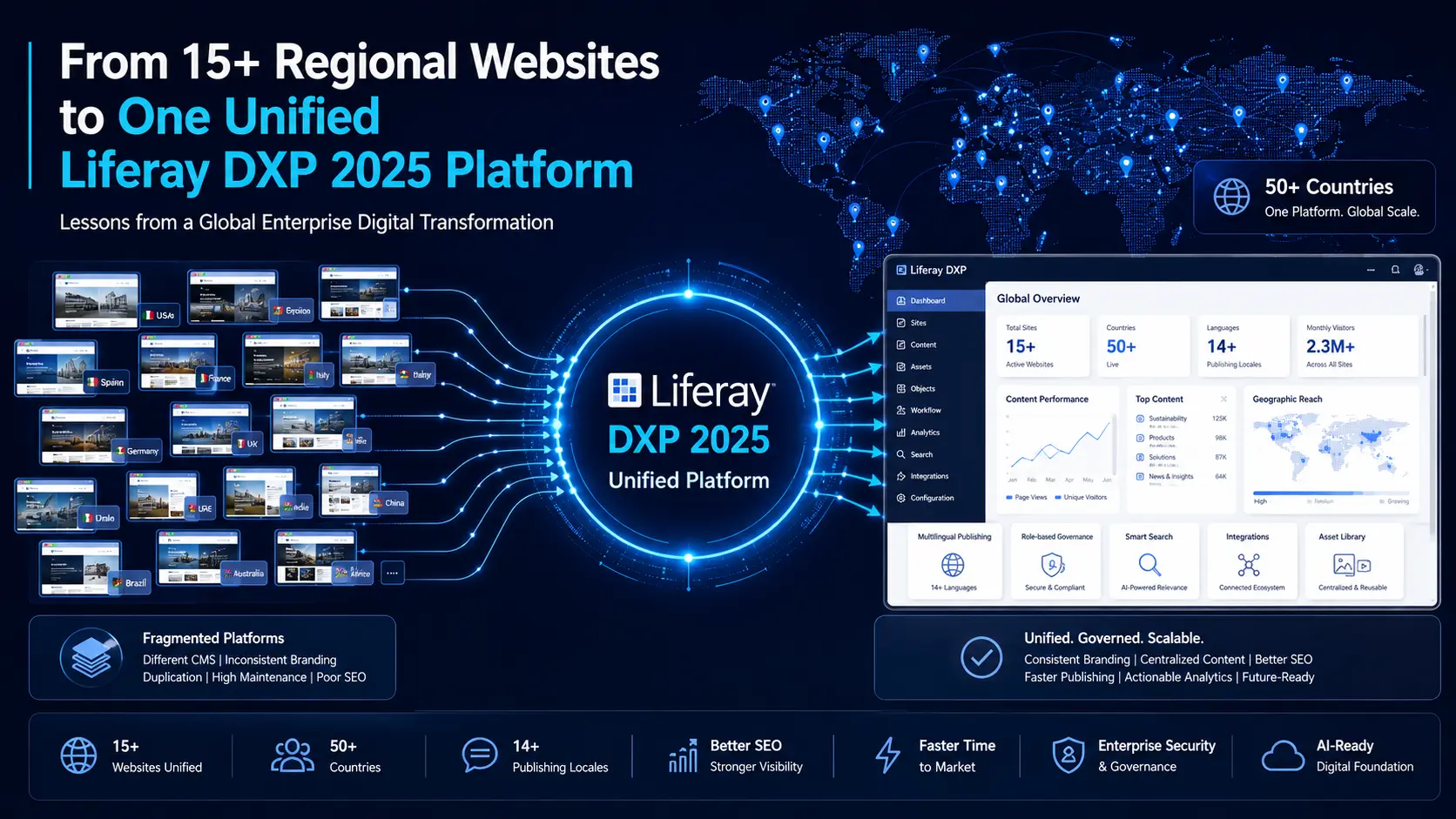
That’s roughly where a global building-materials manufacturer found themselves when they came to us. They operate in 50+ countries, employ 46,000+ people, and by the time we got involved, had 15+ separate, country-specific websites – each one built and maintained on its own.
Sound familiar?
Maybe you’re juggling separate regional sites right now. Maybe your branding looks a little different depending on which country a visitor lands in. Or maybe you’ve noticed your search rankings slipping and can’t quite figure out why. If any of that rings a bell, keep reading – this one’s for you.
What Fragmentation Was Actually Costing Them
- Localization and brand consistency were nearly impossible to manage at scale.
- Search engines were indexing internal, technical URLs instead of actual content, quietly hurting SEO.
- Poor crawlability was limiting visibility in global search results.
- Every region had its own templates, layouts, and user experience.
- A high volume of technical documents and content had no centralized way to manage it.
- Store and distributor location data didn’t match up from one country to the next.
None of this shows up as one dramatic failure. It shows up quietly – search traffic drifting down, maintenance costs creeping up, new content taking longer to publish, and a brand that looks slightly different depending on where in the world someone’s visiting from. That’s exactly why problems like these are so easy to put off. They don’t hurt until they’ve already added up.
What We Built: One Platform, Global Scale
We consolidated their entire digital footprint onto a single Liferay DXP 2025 platform – governed centrally, but flexible enough for every region to run its own show within it.
SEO & Search
We fixed the indexing problem at the root structured data, sitemap optimization, and strict URL governance, so every site is properly crawlable. That's the piece that had been quietly suppressing their visibility for years.
Centralized Content Management
Instead of managing specs, reports, and media across 15+ disconnected systems, everything now lives in one place, using Liferay Objects and dynamic content models.
True Multilingual Publishing
The platform now publishes in 14+ languages. Regional teams still manage their own content day-to-day, but nobody drifts off brand while doing it.
Real-Time Location Intelligence
A stockist and distributor locator now keeps location data accurate across all 50+ countries, powered by Yext and Uberall integrations.
Marketing Automation That Converts
We plugged in Eloqua for lead capture and nurturing, along with GTM and GA4 for analytics. The site stopped being just a brochure and started actually generating leads.
Governance Built for Scale
Role-based access, structured approvals, audit trails, bulk operations - the boring but essential stuff that keeps a platform this size from becoming chaotic, without forcing every region to wait on one central team.
Built on Liferay DXP 2025 - Not Just DXP 7.4
Worth calling out explicitly: this platform runs on Liferay DXP 2025, the current generation of the product – not the older 7.4 release most multi-site projects were built on a few years back. That distinction matters, because the newer platform brings real capabilities that make a unified, multi-site setup meaningfully easier to run:
- AI-Powered Smart Search – Relevance-tuned search across every site, so users find the right content instead of just matching keywords.
- AI Hub for Content & SEO – Automated tagging, auto-translation support, and SEO optimization assistance built into content workflows, not bolted on afterward.
- Centralized Asset Library – Documents, images, and media reused across regions instead of duplicated site by site.
- Stronger Role-Based Governance – More granular control over who can publish what, where, across a large multi-region team.
- More Connected Integration Ecosystem – Easier, more standardized ways to plug in marketing, analytics, and location tools.
- Enterprise-Grade Security – Compliance and access controls that hold up under audit, even at global scale.
For any organization evaluating a similar move today, this is the version worth building on – a meaningfully stronger starting point than it was even two years ago.
A Practical Framework: How to Unify Your Own Multi-Site Presence
If you’re considering this kind of consolidation yourself, here’s roughly how we’d approach it – the same sequence we followed here:
- Audit before you architect. Map every regional site, every template, and every integration currently in use. You can’t design a unified platform around a problem you haven’t fully sized up.
- Fix URL and SEO governance early. This is the single most common mistake – migrating content without fixing how it’s indexed just moves the SEO problem to a new platform.
- Design for regional autonomy within global consistency. Regional teams need to move fast without a central bottleneck, but every region still needs to look and feel like the same company.
- Centralize content and assets from day one. Retrofitting a shared asset library after 15 sites are already live is far harder than building it in from the start.
- Roll out in phases, not all at once. A phased regional launch lets you catch issues early, before they’re replicated across 50+ countries.
- Treat governance as a feature, not an afterthought. Role-based access, approvals, and audit trails need to be designed alongside the platform – not added once something goes wrong.
Why Liferay DXP - and Why It Matters for You
We picked Liferay DXP for this project, and honestly, we’d recommend it to any organization dealing with this kind of multi-country complexity. Here’s why:
- Multi-Site at Scale – One platform governing 15+ sites and 14+ locales with shared templates and design.
- SEO-First Architecture – Structured data and URL governance built for global search visibility from day one.
- Headless APIs – Straightforward integration with marketing, location, and analytics tools you likely already use.
- Reusable Fragments – Fast, governed content authoring so regional teams move quickly without going off-brand.
- Multilingual & GDPR-Ready – Compliant consent management built in across every locale.
- Enterprise Scale – A Docker-based, cloud-deployed architecture tuned for high-volume global traffic.
The Results
- A significant uplift in global search indexing
- Elimination of internal URL exposure that had been hurting SEO
- Improved crawlability across all 15+ sites
- Structured data enabling richer search results
- Consistent, responsive experience across 50+ countries
- Multi-language publishing across 14+ locales
- An advanced stockist locator with real-time location data
- Improved lead capture through marketing automation
- Role-based access control with full audit trails
- Real-time CO₂ and ESG data visualization for stakeholders
- Consistent analytics (GTM + GA4) across all global properties
- GDPR-compliant consent management platform-wide
Why Companies Choose Inexture for Liferay Implementations
This wasn’t a quick project we shipped and walked away from – it’s a partnership that’s now in its fifth year. That’s not an accident. It’s how we tend to work:
- Deep Liferay Expertise – We’ve delivered Liferay DXP projects across manufacturing, government, and enterprise sectors – everything from multi-site architecture to complex headless integrations.
- We Think Past the Launch Date – SEO, governance, and analytics went in from day one here, not as an afterthought once something broke.
- We Tend to Stick Around – Most of our engagements turn into ongoing partnerships, because a platform like this needs to keep evolving as your business does.
- We Care About the Business Outcome, Not Just the Build – Every decision on this project traces back to something real: better search visibility, better lead capture, and easier governance.