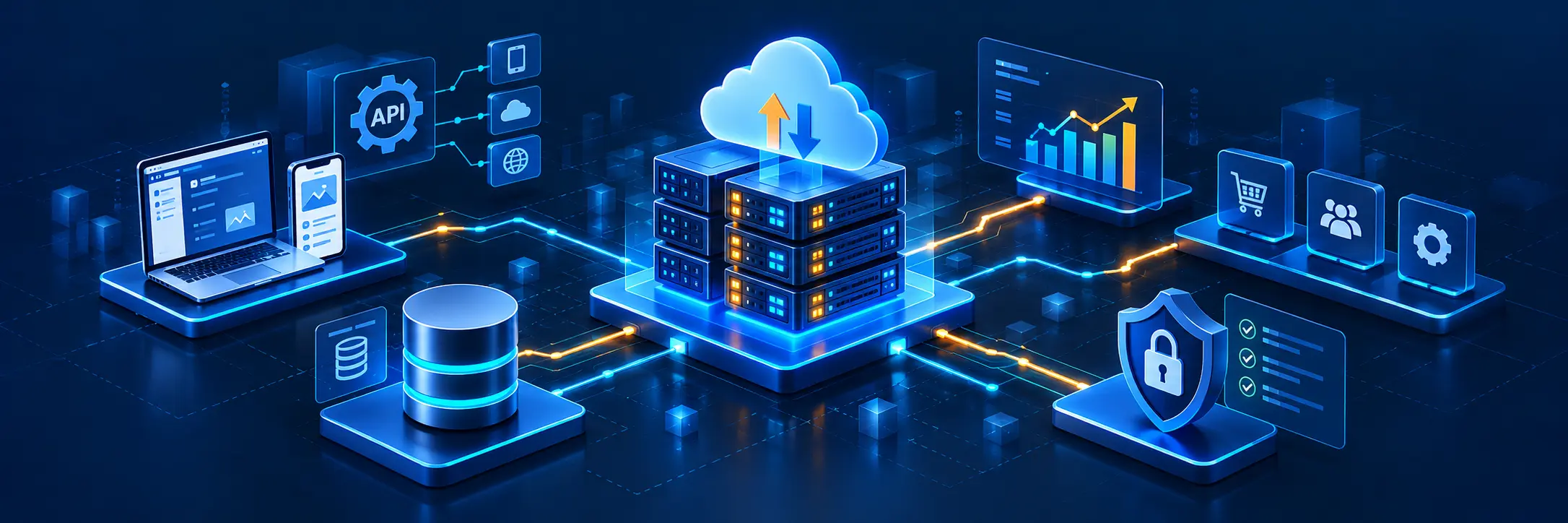
Every successful digital product needs a reliable backend. From processing transactions and managing customer data to connecting applications through APIs, backend systems power the functionality users depend on every day.
As businesses grow, a backend that once worked well may struggle with increasing traffic, complex integrations, and evolving requirements. Backend development services help businesses build systems that are secure, maintainable, and ready to scale.
Whether you’re launching a new product or modernizing an existing platform, the right backend architecture can turn an idea into a dependable digital solution.
What Are Backend Development Services?
Backend development services focus on the server-side components that make applications work behind the scenes. These components manage business logic, databases, authentication, APIs, integrations, and data processing.
For example, an e-commerce platform relies on its backend to manage product inventory, process orders, update payments, and track deliveries.
Businesses can also explore building a production-ready microservices platform to understand how backend services can be structured for complex applications.
Key Backend Development Services
A well-designed backend supports both current business needs and future product growth. Common services include:
- Custom backend development: Build server-side functionality tailored to specific business workflows.
- API development and integration: Connect applications, third-party services, and enterprise systems.
- Database design and management: Organize data for reliable access, consistency, and performance.
- Authentication and security: Protect user accounts, sensitive information, and application resources.
- Performance optimization: Improve response times and resource utilization as usage increases.
- Backend modernization: Improve legacy systems without unnecessarily disrupting existing operations.
For performance-focused applications, our guide to Django Performance Optimization: 25 Proven Tips (2026) can provide a relevant next step.
Choosing the Right Backend Architecture
The right architecture depends on your product’s complexity, team capabilities, budget, and expected growth. Not every application needs a distributed system from day one.
| Architecture | Best suited for | Key consideration |
|---|---|---|
| Monolithic | Small applications and early-stage products | Simple to develop and deploy |
| Modular monolith | Growing applications with clearly separated business domains | Maintains structure without distributed-system complexity |
| Microservices | Large platforms with independently evolving services | Requires stronger monitoring and operational practices |
| Serverless | Event-driven workloads and variable traffic | Depends on platform capabilities and execution limits |
A modular monolith is often a practical starting point. As independent scaling or deployment becomes necessary, specific components can be separated into services.
For a deeper look, explore Build Microservices in Python: Business Guide.
Building Secure and Scalable Backend Systems
A reliable backend requires more than choosing a framework. It needs deliberate design decisions across security, performance, deployment, and monitoring.
1. Design APIs for Long-Term Use
Consistent endpoints, clear error responses, input validation, authentication, and versioning help APIs remain easier to maintain as products evolve.
See Microsoft’s API implementation best practices for additional guidance.
2. Optimize Performance Early
Database indexing, caching, efficient queries, background processing, and appropriate resource allocation can reduce response times and improve user experience.
3. Make Security Part of the Design
Use appropriate access controls, secure credential handling, input validation, encryption where needed, and dependency updates. Security should be considered throughout development rather than added at the end.
The OWASP Top 10 is a useful reference for understanding common web application security risks. You can also explore stateless JWT authentication.
4. Prepare for Growth
Monitor application performance, define recovery procedures, and test how the system behaves under increased demand. Microsoft’s guidance on reliability and scaling strategies offers useful principles for designing resilient systems.
Choosing Between SQL and NoSQL Databases
Choosing the right database depends on your application’s data structure, consistency requirements, and expected workload.
SQL databases are well suited to structured data, relational queries, and transactions that require strong consistency, such as financial records, orders, and inventory.
NoSQL databases can be useful for flexible data models, high-volume workloads, or access patterns that benefit from document, key-value, or other non-relational storage.
For example, an e-commerce platform might use SQL to manage orders and payments while using a NoSQL database for flexible product catalogs or application events. However, using multiple databases adds operational complexity, so start with the simplest option that meets your requirements.
Backend Testing: Ensuring Quality and Reliability
Backend testing helps identify problems before they affect customers or business operations. A reliable testing strategy typically includes three essential types:
- Unit testing: Verifies individual functions, business rules, and components in isolation.
- Integration testing: Checks whether APIs, databases, external services, and other components work together correctly.
- Load and performance testing: Evaluates response times, throughput, and system behavior under expected and peak workloads.
Combining these tests helps teams catch defects early, validate critical workflows, and build confidence before releasing new features.
Logging, Monitoring, and Alerting
A backend can experience errors even when its user interface appears to work normally. Logging, monitoring, and alerting help teams identify and resolve these issues before they cause significant disruption.
- Logging records application events, errors, and relevant diagnostic details.
- Monitoring tracks metrics such as response times, error rates, resource usage, and database performance.
- Alerting notifies the responsible team when important thresholds or failure conditions are detected.
For example, a sudden increase in failed payment requests could trigger an alert, allowing the team to investigate before more customers are affected. Logs should avoid exposing passwords, access tokens, and sensitive personal information.
Backups, Disaster Recovery, and Data Migration
Reliable backend systems need a plan for recovering data and restoring services after accidental deletion, system failure, or other disruptions.
- Backups: Schedule regular backups and protect them from unauthorized access or accidental deletion.
- Disaster recovery: Define recovery procedures, responsibilities, and recovery time and data-loss targets.
- Data migration: Plan schema changes and data transfers carefully, validate results, and maintain a rollback or recovery strategy where feasible.
Backups should be tested through actual restoration exercises. A backup is only useful if the business can recover the required data within an acceptable timeframe.
Rate Limiting and Secrets Management
Backend security involves protecting both application access and the credentials used to connect systems.
Rate limiting restricts how frequently a client can call an API within a defined period. It helps reduce abuse, protect resources, and control excessive requests. Limits should be designed around the endpoint, user type, and business requirements.
Secrets management protects sensitive values such as database passwords, API keys, signing keys, and service credentials. Store these in an appropriate secrets manager or secure environment configuration, restrict access, and rotate credentials when necessary. Avoid committing secrets to source control or exposing them in logs.
Together, these practices help reduce unauthorized access and improve backend resilience.
Why Database Design and Documentation Matter
Poor database design can create performance bottlenecks, duplicate or inconsistent data, difficult schema changes, and costly maintenance as an application grows. Clear relationships, suitable indexes, appropriate constraints, and deliberate data models help prevent these problems.
Documentation is equally important. API contracts, database schemas, architecture decisions, deployment procedures, and recovery instructions help developers understand how the system works and how to maintain it safely.
Without documentation, teams may repeat investigation, introduce avoidable errors, or struggle when the original developers are unavailable. Treat database design and documentation as ongoing responsibilities rather than one-time tasks.
Product Ideas You Can Build with Backend Development
Backend capabilities can become the foundation for products that solve real business problems. Consider these opportunities:
- Inventory intelligence platform: Track stock levels, forecast demand, and notify teams about potential shortages.
- Customer self-service portal: Let customers manage requests, track progress, and access account information.
- Unified operations dashboard: Bring data from different business systems into one workspace.
- Smart booking platform: Manage availability, reservations, reminders, and cancellations.
- Real-time order tracking: Connect order processing, inventory, delivery updates, and customer notifications.
The strongest product ideas begin with a clear problem. Identify a repetitive process or operational bottleneck, build a focused solution, and expand based on actual user feedback.
Common Backend Development Mistakes to Avoid
Even a technically functional application can become difficult to maintain if important design decisions are overlooked.
- Overengineering too early: Avoid unnecessary microservices and infrastructure before the product needs them.
- Ignoring security: Build authentication, authorization, and data protection into the system from the start.
- Neglecting monitoring: Track errors, latency, and resource usage to identify issues before they affect users.
- Tightly coupling components: Separate business responsibilities so changes are easier to manage.
- Skipping scalability testing: Validate performance under realistic workloads instead of relying on assumptions.
Conclusion
Backend development is more than building the systems behind an interface. It creates the foundation for reliable user experiences, efficient business operations, and products that can evolve over time.
By choosing the right architecture, prioritizing security, and designing for maintainability, businesses can build digital solutions that address today’s challenges while leaving room for future growth.
Have an idea for a digital product or need to modernize an existing application? Start by identifying the problem, defining the essential features, and designing a backend around your business goals.
FAQs
What does a backend developer do?
Yes. A product can be designed around a specific workflow such as stock research, portfolio monitoring, earnings analysis, market alerts, or financial sentiment analysis.
When should a business invest in custom backend development?
How do backend services help an application scale?
Should every application use microservices?
Security should include authentication, authorization, data protection, least-privilege access, input/output validation, monitoring, and controls for AI-specific threats such as prompt injection.