Custom Software Development for Enterprise Business — Architecture, Cost & Implementation Guide (2025)
By Dharmesh Patel February 1, 2024
Why Enterprises Choose Custom Software
Enterprise organizations rarely fit into rigid SaaS tools. As scale increases, so do operational complexity, integration needs, and security requirements — especially around authentication, authorization, and compliance. This is why enterprises increasingly invest in platforms with built-in Enterprise Identity & Access Management (IAM) solutions rather than relying on fragmented tools
Custom enterprise software enables organizations to:
- Align technology directly with business workflows
- Integrate deeply with ERP, CRM, and legacy systems
- Scale securely across teams, regions, and products
- Maintain full control over data, IP, and security
- Reduce long-term licensing and vendor lock-in risks
This is why enterprises across finance, healthcare, logistics, government, manufacturing, and SaaS invest in custom-built platforms.
What Is Custom Software for Enterprise Business?
- Internal workflows
- Organizational hierarchy
- Compliance frameworks
- Data governance policies
- Long-term scalability
- Internal business platforms
- ERP extensions
- Customer & partner portals
- Workflow automation systems
- Data & analytics platforms
- AI-powered decision systems
Where Enterprises Use Custom Software
- Internal Operations Platforms
- Customer & Partner Portals
- Supply Chain & Logistics Systems
- Financial & Compliance Platforms
- HR & Workforce Management
- Healthcare & Patient Systems
- Government & Public Sector Platforms
- AI & Data Platforms
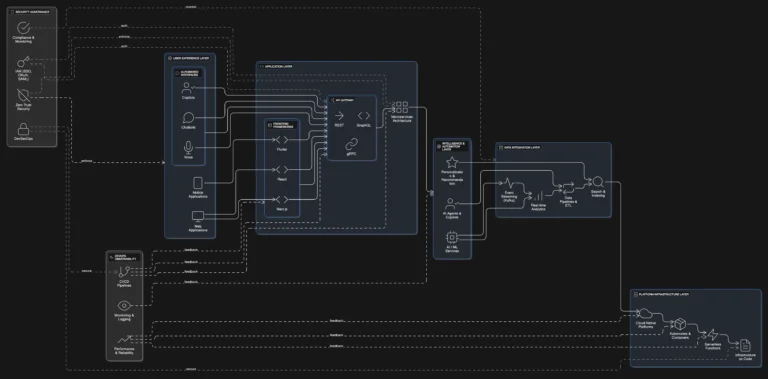
Enterprise Software Architecture Overview
At the core of enterprise-grade platforms lies robust Backend Engineering, enabling scalable APIs, secure integrations, and reliable business logic across distributed systems
Common architectural components include:
- Frontend (Web, Mobile, Admin Panels)
- API Gateway
- Application Services (Microservices / Modular Monolith)
- Integration Layer (ERP, CRM, Legacy Systems)
- Data Layer (RDBMS, NoSQL, Analytics)
- Security Layer (IAM, SSO, RBAC)
- Cloud Infrastructure & CI/CD
Technology Stack for Enterprise Software Development
Frontend
- React, Angular, Vue
- Mobile: Flutter, React Native
Backend
- Java (Spring Boot)
- .NET
- Node.js
- Python (Django, FastAPI)
Databases
- PostgreSQL, MySQL
- MongoDB, Cassandra
- Data Warehouses (Snowflake, BigQuery)
Cloud & DevOps
- AWS / Azure / GCP
- Docker, Kubernetes
- CI/CD pipelines
Security
- OAuth2, SSO
- Role-based access control
- Encryption & audit logging
Enterprise Custom Software Development Cost
| Complexity Level | Cost Range |
|---|---|
| Department-level system | $40,000 – $90,000 |
| Multi-module enterprise platform | $90,000 – $250,000 |
| Large-scale enterprise ecosystem | $250,000 – $700,000+ |
Costs rise further when platforms require advanced analytics, reporting, or real-time data pipelines — often implemented through Data Engineering & ETL solutions.
Cost Drivers
- Number of users & roles
- Integrations (ERP, CRM, legacy)
- Security & compliance requirements
- Cloud & DevOps complexity
- Data & AI components
Typical Enterprise Software Timeline
- Discovery & Architecture: 3–6 weeks
- UX & System Design: 3–5 weeks
- Core Development: 3–6 months
- Integrations & Testing: 1–3 months
- Deployment & Rollout: 2–4 weeks
Total: 4–9 months, depending on scope.
Integration and testing phases often take longer in enterprise environments due to dependencies on ERP, CRM, and third-party services managed via API Platforms & Integration Ecosystems
Why Inexture for Enterprise Software Development?
- Proven enterprise delivery experience
- Strong backend & system architecture expertise
- Secure, compliance-ready engineering
- Deep integration capabilities
- Cloud-native & DevOps-driven delivery
- Long-term partnership mindset
Our experience includes delivering complex enterprise integrations such as the Secure File Transfer ETL platform, where security, automation, and compliance were mission-critical